

Sometimes ideas strike like lightning - fast, hot and impactful. There is an energy and excitement that surges to take a concept toward practice. In educational leadership, there is often heated tension between the ideas that come and the actions that follow. Moving too swiftly on an innovative idea can lead to failure to ignite, moving too slowly can cause the embers of excitement and enactment to smother.
These dynamics are what educational leaders grapple with as they work to keep systems moving forward, guided by the sparks of curiousity, creation and improvement at the centre of decision making and innovation.
Mental health in schools is a conversation charged with tremendous energy. Focusing on wellness for all within public education requires not only a culture of care and commitment to wellbeing, but also an aligned, cohesive structure to ensure mental health is both an instructional and system priority.
This past weekend, I had the opportunity to take part in the University of Calgary, Werklund School of Education Mental Health Summit lightning talks. I had never done a lightning talk before and, to be honest, felt a little apprehensive about preparing for the thought storm of academic sharing and practical feedback.
What I discovered instead was a cool surge of energy and a room full of unique ideas as we shared our sparks and sought feedback from researchers and practitioners across Canada. While the session itself was a meaningful experience, what has been most impactful are the conversations ignited following my lightning talk. These exchanges are creating an unexpected new weather system, one where assessment, data, and accountability intersect with care, context, and purpose to strengthen how we approach mental health in schools.
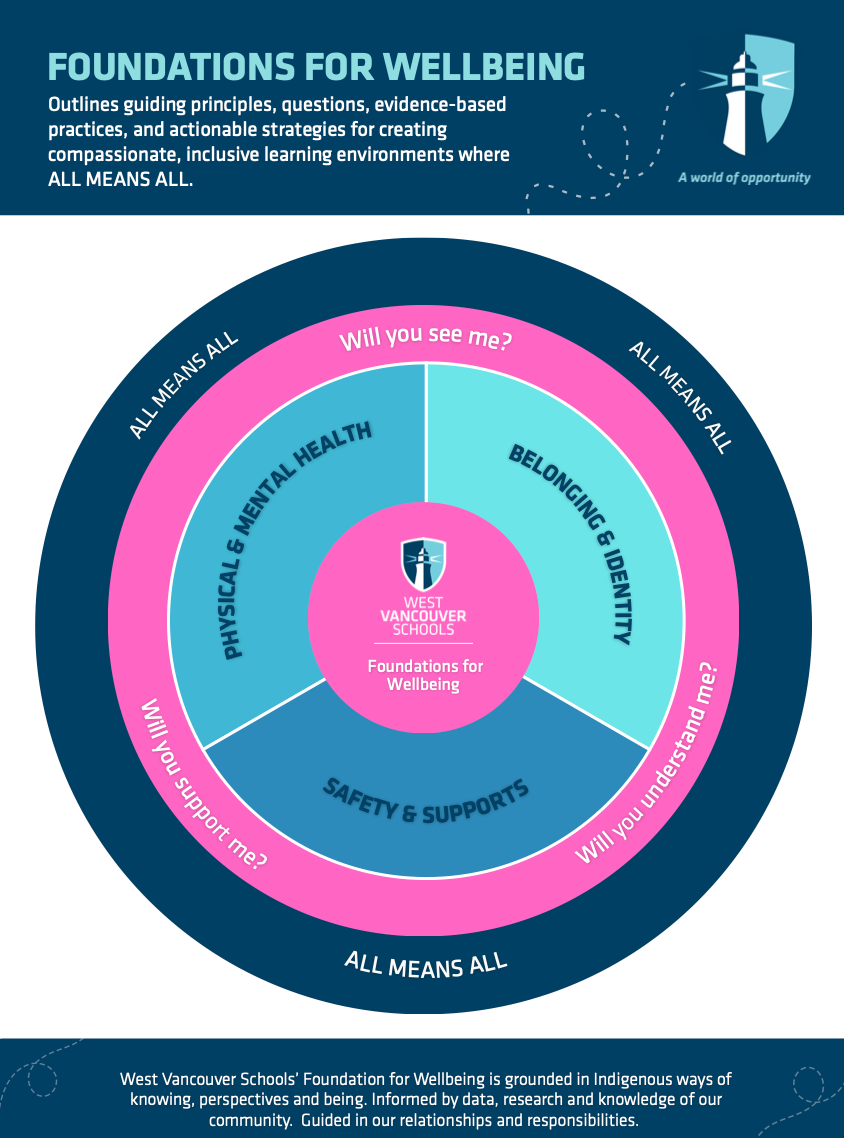
Building on our draft Foundations for Wellbeing (below) framework, my lightning talk explored how these principles help set direction for the work ahead.
My lightning talk (below) highlights how our school district is starting to reset the foundations for wellbeing and set direction for the work ahead. This is not my work alone; rather, it is the result of countless hours of collaborative discussion, deep consideration, and, at times, heated debate about how we modernize our framework for mental health in schools. Together, this work is creating new pathways toward ensuring that human wellness becomes the root system of educational excellence.
LIGHTNING TALK FORMAT:
- A 4‑minute talk followed by 1 minute of questions, repeated across four rotating table groups.
MY LIGHTNING TALK:
Foundations for Wellbeing: A Simple Framework with Transformative Impact
Designing for inclusivity appears to be wickedly complex.
But what if it didn’t have to be?
What if there was a practical blueprint for creating compassionate school environments where all really means all?
Before a student can learn, they’re quietly asking us 3 questions
· Will you see me?
· Will you support me?
· Will you understand me?
In West Vancouver Schools when we say all means all, we are not talking about intent.
We are talking about Systems, Spaces, Practices… designed so that students don’t have to ask for exception or explanation.
This lightning talk introduces our Foundations for Wellbeing – a district wide framework where:
1. Safety enables belonging
2. Belonging supports identity
3. Identity strengthens mental and physical well-being
4. Well-being makes learning possible
These are not separate initiatives or programs.
They function like roots. Invisible when they’re working but everything collapses without them.
Think about the student who is slowly disengaging, attendance slipping, work incomplete.
On the surface, it looks like a motivation problem. Someone not trying hard enough or not caring enough. But when we focused first on safety, predictable routines, relational check-ins, flexibility… grace, the student didn’t have to explain or defend or justify their needs.
Belonging came first.
And once that student felt seen and supported, learning became possible again.
This framework is grounded in Indigenous ways of knowing.
- It is relational.
- It is holistic.
- It is responsibility based.
- It is bigger than our immediate selves.
- It reminds us that wellbeing isn’t individual, it is COLLECTIVE.
In this framework all means all moves from belief to design. Equity and excellence are not competing goals, they are achieved together. When systems are intentionally designed around learner needs - access and high expectations coexist. This is not a slogan or a nice idea, it's commitment that asks us to see wellbeing as the foundation, not an intervention or problem to be solved or program to be completed.
All means all requires the interconnection of
- Safety
- Belonging
- Health
Because wellbeing is the CONDITION for all learning.
At its heart foundations for wellbeing is not a checklist.
It is a values-based framework for learning environments where all means all.
And ultimately, it is our collective answer to those three quiet questions:
- Will you see me?
- Will you support me?
- Will you understand me?
When the foundations are not in place, students don’t disengage because they don’t care.
They disengage because the environment doesn’t yet feel safe for learning.
In conclusion, our foundations for wellbeing reminds us that every decision we make should answer one question:
Does this help someone feel seen, feel supported, feel understood?
If it doesn’t, we haven’t built the conditions for all means all – yet.
This past weekend, I shared our district’s evolving foundations for wellbeing as a lightning talk - not to present answers, but to strike a point of energy and invite feedback.
People tend not to give feedback on wellness frameworks because they are values‑laden. Yet, in this early phase, as we move into student, teacher, parent and staff focus groups, we want to learn. We are committed to ensuring cycles of improvement that are not just earnest, but effective.
The intention of my lightning talk at the Mental Health Summit was to light dialogue and to illuminate wellness as a critical part of education, particularly as we commit to educating the entire human experience. I also wanted, and needed, to position what all means all truly means, and to caution against the practice of firing up practices, pedagogy and programs as the solution for doing this deep work. Instead, I wanted to ignite the values and visioning necessary to build the root system required for authentic, lasting growth.
Kimberly Schonert‑Reichel reminds us that “what’s not assessed is not addressed.” In the spirit of her wisdom, I am inviting feedback to help us move forward. As we commit to all means all in our schools, here are four questions to spark your feedback:
- What’s one assumption in this foundation that deserves to be tested?
- What feels modernized, and what still feels outdated?
- Where might accountability strengthen wellness, and where might it unintentionally constrain it? What kinds of accountability helps us better care for people?
- What data points should we be exploring, and how do we ensure that assessment supports wellness without reducing it to compliance?
Author's Note: Feedback is welcome, and you know how to find me. Thank you in advance for sharing your constructive thinking.
Once again, in the spirit of author integrity, I note that my Copilot AI thought partner assisted with light editing and grammatical revisions to assist with publication.