

It is time to confront the truth that has quietly shaped, and limited how we teach reading. The long‑standing fallacy that reading is taught only by primary educators has harmed our profession and left too many students drifting, narrating their learning stories with, “I don’t like reading,” or “I’m not a reader.”
I debated titles for this spin and even did an AI search for ideas, but I found myself getting overwhelmed, stuck between the words and the message. At first I wondered why I was fumbling, but then I realized that the scope of what has been consuming my mind is massive.
Along with many other educators, I am grappling with the fact that we have not gotten this right in our schools. Too many students move through the grades missing key literacy instructional components needed to become fluent, confident readers who can see themselves, now and in their future lives, as readers. This is not okay, and it is time to confront the practices that are not supporting our students, while recognizing that literacy is a long game requiring ongoing, intentional, and strategic plays to ensure students thrive as readers throughout their entire educational journey.
Literacy can’t be front‑loaded in the early years and then assumed to be secure. As students’ learning experiences expand, their need for direct literacy instruction beyond the primary (K–3) years becomes even more important. There is a clear pathway between literacy development and health outcomes, reinforcing the idea that stronger literacy skills contribute to better lifelong health, an important insight for student populations (MacDonald, 2022). While much of the research focuses on adults, it supports a broader theoretical connection: strong literacy acquisition in childhood and adolescence functions as a preventative factor, integrating health, well‑being, and overall literacy development.
If a stronger argument is needed, we can position the Matthew Effect. First coined by Robert K. Merton, the term was originally used to explain why well‑known scientists receive more recognition than equally capable but lesser‑known researchers. The Matthew Effect describes how early success compounds over time, while those who start with fewer advantages often fall further behind.
In literacy development, Keith Stanovich (1986) used this concept to explain the widening gap between readers: those who start with stronger skills continue to grow rapidly, while those who start lower progress more slowly. Stanovich highlights the reciprocal relationship between reading development and cognition, where skills such as phonological awareness shape reading acquisition, and reading in turn reinforces underlying cognitive processes.
Charles Perfetti’s (1985) verbal efficiency theory extends this understanding. He shows that low‑achieving readers begin with less linguistic knowledge on which the verbal processing system is built. Limited reading experiences then prevent them from developing the rich, redundant network that high‑achieving readers acquire, reinforcing long‑term gaps in reading efficiency. Ultimately, this leaves struggling readers at a perpetual disadvantage.
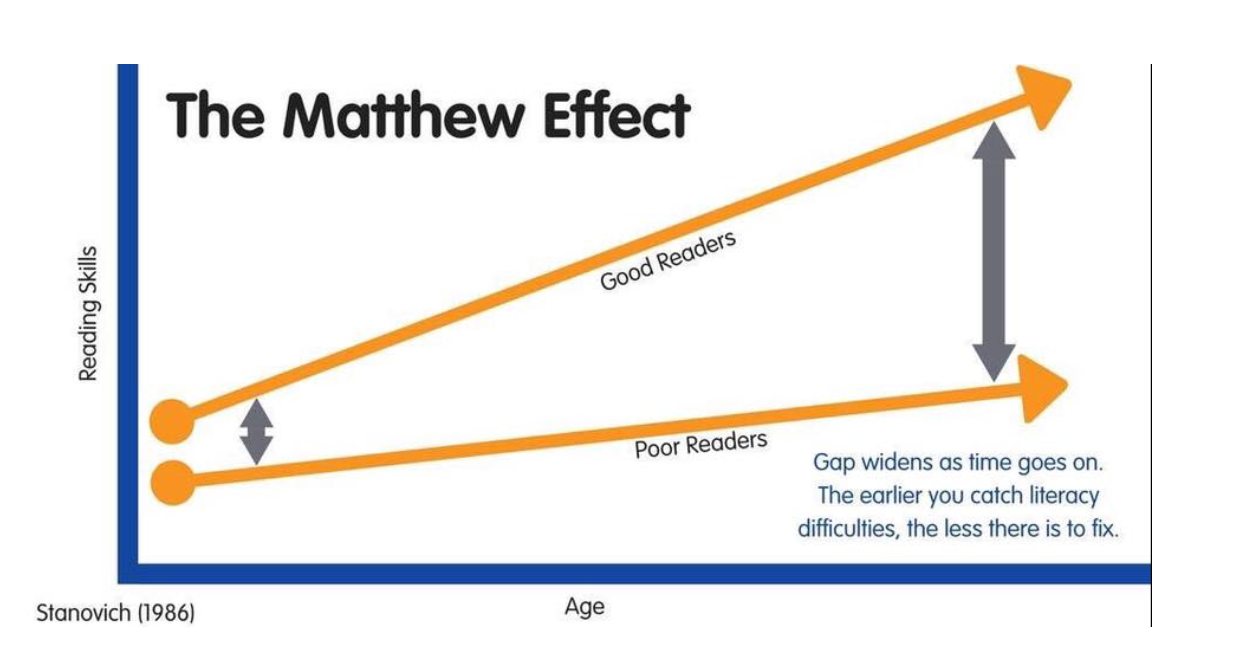
These reciprocal effects create a dangerous trajectory in schools, as catching students before they fall becomes increasingly difficult once the gap begins to widen. Repositioning hope alongside strategy in reading instruction requires educators across all subject areas to assume shared ownership for teaching reading. This does not mean teachers are being asked to do more; rather, it calls for greater awareness of students who struggle with literacy and a commitment to collaboratively identifying where the gaps lie so growth can be supported.
Screeners are not a bad word; they must continue to be repositioned as essential tools for understanding and identifying where students are in their learning journey, not as labels. Once we know where students are, we can determine what they need and be strategic about how resources are used so that individual teachers are not left carrying the entire weight of responsibility. The following sections outline ways we can rethink how we position literacy within the broader play of schooling, committing to doing differently so we can do better for all students.
Playbook Error #1: “They’ll Grow Into It”
When it comes to literacy instruction, I’m going to be bold: wait‑and‑see isn’t a strategy, it’s a setback. Some may argue that most students will eventually “crack the code” without much direct instruction as they mature, but the Matthew Effect is real for a significant number of students who won’t. Prevention and resilience go hand in hand in reading development, and the Grades 4–12 window is a powerful period to continue this work. Brains change dramatically during these years, making it an ideal time to help students become readers and writers. While early intervention is optimal, it is never too late to provide direct instruction and support to struggling adolescent readers.
Playbook Fix #1: Act Early - Intervention Prevents the Matthew Effect
The idea of literacy screening as a concept is itself a protective factor. Screeners help us identify whether students are at risk for current or future struggles in reading development. Many provincial ministries of education in Canada are now directing school districts to implement literacy screening measures. While new directives may bring initial growing pains, the practice of screening students to assess literacy skills is essential. Without assessment, it is impossible to determine, at a technical level, who needs what and when within our classrooms.
Districts must work toward implementing screening measures that are reasonable from both a time and application perspective, including clear directions on progress monitoring and appropriate interventions. In my district, we are learning how important relationships are in the literacy assessment process. Investing in district literacy teachers who are skilled in the foundations of literacy and able to work alongside classroom teachers is proving to be hugely successful. Implementing evidence‑based screening tools, paired with dedicated time for completing snapshot assessments, is already resulting in swift increases in student literacy scores.
Having classroom teachers implement the screeners is critical, as they have the strongest relationships with their students. This positions specialist teachers in a supportive role during assessment, assisting with the implementation of screening tools, organizing data, analyzing and interpreting results, and helping plan targeted instruction. When specialists, such as learning support teachers or ELL teachers, conduct the full sweep of assessments themselves, it undermines the purpose of screening. As we rewrite the literacy playbook for the long game, we must support this approach by ensuring that screeners do not become “one more thing” on an already full plate for classroom teachers. This requires leadership to prioritize scheduling, make intentional decisions about what may need to be set aside, and create the conditions for this preventative work to be done well.
Assessment must be authentic, accessible, ongoing, and informative for educators to use it effectively. This is especially true for struggling readers who need selective attention, close observation, and formal screening. Formal screening tools are not full diagnostic tests, and they are not labels; they are early warning systems that signal when a student needs more attention. Without this information to guide targeted intervention, the gap continues to widen, and these students will not simply “be fine.”
Playbook Error #2: "They're going to be fine"
One of the most heartbreaking side effects of reading difficulties is the story of self that emerges in students, a story filled with internal messages of not being capable, of failing and falling behind, which is not what any of us want for our learners. The detrimental impact of low literacy skills on human health and wealth is well documented. Research consistently shows that individuals who struggle with literacy face lifelong challenges economically, emotionally, and socially.
Literacy empowers and liberates people (UNESCO, 2025), making it the core of enterprise schooling. We must assume ownership for the holistic development of our students, which includes nurturing their perceptions of capability and competence. Educators can act as “preventionists,” intentionally building executive functions through strategic and direct instruction, skills that serve as resilience factors (more on this in my next spin). Literacy is a core aspect of the foundations of wellness as educators centre instructional planning on all meaning all, ensuring that all students are considered and prioritized when designing all impactful literacy practices, and that lack of progress or growth is never accepted for any learner.
Playbook Fix #2: Targeted, Skills‑Based Instruction Accelerates Growth
The science is clear: here is what works. Grounded in the science of teaching reading, there are five big skills students must master to become literate.
- Phonological Awareness: understanding and manipulating the sounds in words (e.g. rhymes, phonemes, syllables).
- Alphabetic Principle: linking sounds (phonemes) to letters or spelling patterns (graphemes), sometimes referred to as phonics.
- Accuracy & Fluency: reading connected text with accuracy, prosody and speed to support comprehension (e.g. can I read words individually and correctly?).
- Vocabulary: knowing the meaning of words and their relationships involves helping students accrue new words in all areas taught.
- Comprehension: understanding, interpreting and connecting ideas in text
This is the general direction of reading development. Ultimately we read to comprehend, this is the goal and the gateway to competency. Language comprehension is complex, involving background knowledge, vocabulary, language structures, verbal reasoning and literacy knowledge. Hollis Scarborough's reading rope helps to position the many skills students need to have to become proficient readers.
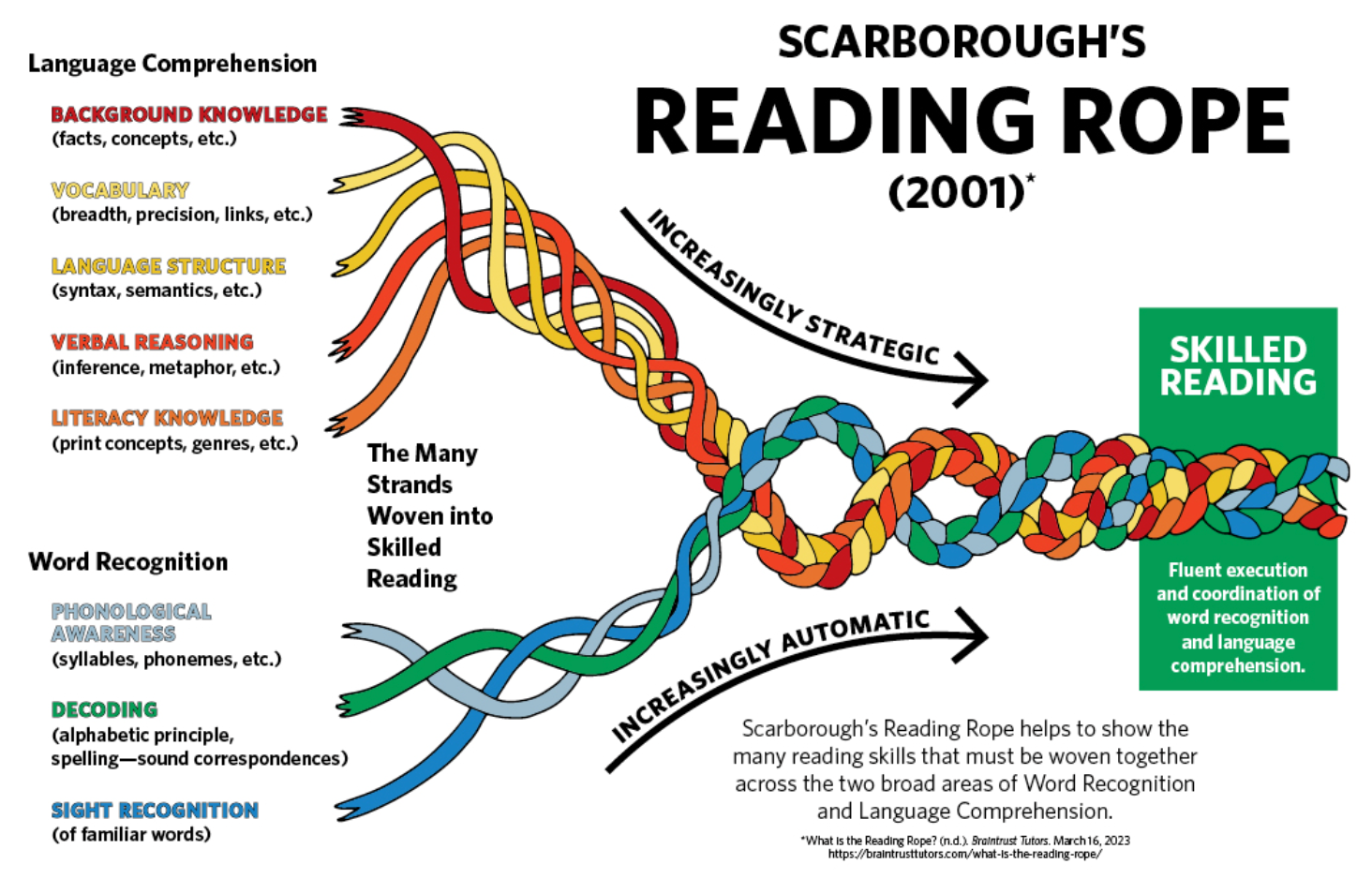
All educators need to understand the processes involved in reading development in order to screen effectively and identify which components of reading are lagging or lacking. It is important to note the tremendous increase in emerging theory, including the Active View of Reading, which is helping educational teams use skills‑based instructional practices to ensure literacy development is both targeted and supported. Moving away from searching for the “right program” to understanding what to do is critical in the redesign of the Grades 4–12 reading playbook.
In B.C., it is an exciting time as our province is investing in teacher resources and training to support both current teachers working in the K–12 system and those in teacher education programs. This includes creating provincial communities of practice, designing curriculum‑aligned guides for literacy instruction and intervention, piloting centres of excellence, and developing an open‑access, online modular series of literacy professional development (B.C. Ministry of Education and Child Care, 2026). This professional learning infrastructure will assist individual public school districts as they continue to build their own repertoires of resources to support educator growth and ensure that teachers have what they need to do this important work.
Playbook Error #3: “Reading just isn’t their thing”
I recognize that this spin is touching on a complex issue in a fairly straightforward way. My aim is to highlight the importance of awareness in schools alongside the strategic repositioning of resources, such as scheduling, screening, and staffing, to ensure we create the conditions to do what works. It is imperative that we think about what we can do to teach all students to read at every stage of their growth and development. This begins with the fundamental belief that all youth can read and have the right to read well beyond early intervention. There is no cost to self‑checking our values and our commitment to all meaning all. A student’s right to read and to a literate future is essential in all Canadian classrooms, because reading is everyone’s thing.
Playbook Fix #3: Reading Is a Human Right and Universally Teachable
Reading is a social justice issue. The Supreme Court of Canada asserts that learning to read is not a privilege for some, but a basic and essential human right for all (2012). Ontario’s Human Rights Commission’s Right to Read inquiry positioned 157 interconnected recommendations for education sector partners, outlining how to uphold that right across systems. While the inquiry focuses primarily on the early years, the issues raised are systemic and require a consistent, system‑wide response. Although early years anchor literacy instruction, every grade level feels the impact when literacy is not viewed as a shared responsibility in upholding the right to read for all learners.
Great progress has been made in literacy with most recent data (UNESCO Institute for Statistics) showing that more than 86 per cent of the world’s population know how to read and write compared to 68 per cent in 1979. Despite this, worldwide at least 739 million adults still cannot read and write (UIS, 2025), two thirds of them women, and 250 million children are failing to acquire basic literacy skills.
UNESCO, 2025
Interestingly, it was just shy of a year ago when I wrote about the reading wars. My aim then was to provoke meaningful conversation, call out unproductive conflict, and recenter the literacy discourse on what matters most: strategically supporting student growth, achievement, and well‑being. Now, just over a year later, I find myself in a similar place of curiosity as the progress in our primary grades begins to unlock real possibilities for system‑wide instructional change in Grades 4–12.
There is a long game to be played in the journey toward literacy. It is short‑sighted to view the early years in isolation, because every developmental phase depends, in some shape or form, on the one that came before it. Initiatives led by amazing educators in my school district, who are pushing into the landscape of reading across disciplines in the secondary context and piloting Grade 8 screening to better understand where students need additional attention, are poised to change the course of literacy development in our secondary schools. This work will reshape how all students are able to unlock content across subject areas.
This is achievable, and reading is universally teachable. It is never too late to teach adolescents to read, especially because the literacy playbook is a network of interwoven skills that includes communicating, writing, spelling, and relating. The intensity of the long game for struggling readers cannot be underestimated. That’s why literacy must remain a top priority, and why we must stay all‑in for all students.
Author’s Note: The act and art of teaching reading is complex, requiring immense time, dedicated resources, and sustained professional learning. This spin is not intended to simplify the complexities of literacy instruction or acquisition. My intent is to position the importance of reading instruction across the entire K–12 system. I am deeply grateful for the close colleagues and daily conversations that continually push my thinking about how we can do better for all students. Their insights helped shape this reflection, along with a touch of assistance from a digital writing tool to support clarity and flow.
